Mary Ruth Organics Lawsuit: What Happened, Who Was Sued, and Is There a Settlement? (2026 Update)
Asher Ortiz - 2026-06-26

Sponsored Ads

Sponsored Ads

If you searched for “MaryRuth Organics lawsuit,” you may have noticed that the information online is surprisingly inconsistent. Some websites discuss a class action, others focus on a 2021 product recall, and still others refer to a trademark dispute or a newer investigation into subscription billing.
The confusion exists because there is not one single MaryRuth Organics lawsuit that accounts for all of these events.
MaryRuth Organics has been involved in several separate legal and regulatory matters involving different products, allegations and areas of law. Understanding those distinctions is important before assuming that a recall was a lawsuit, that a proposed class action has been certified, or that a settlement is available.
This article separates the major matters and explains what the available court, government and legal records actually show.
Important: This article is for general informational purposes and is not legal advice. Pending litigation and regulatory matters can change, so readers should verify current court records before relying on information about a potential claim.
There are four developments that account for most of the online discussion surrounding MaryRuth Organics.
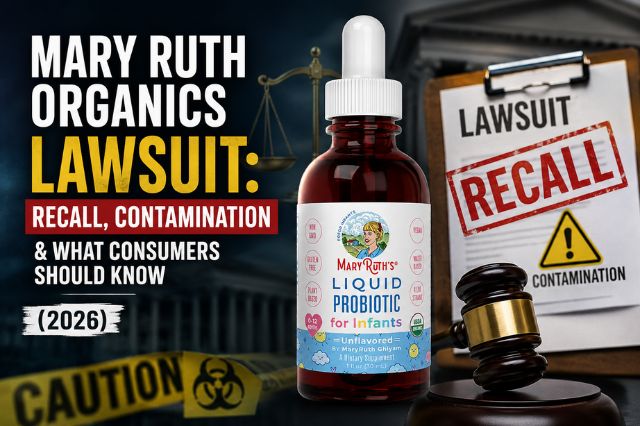
In 2021, MaryRuth announced a voluntary recall of two lots of its Liquid Probiotic for Infants because of the potential for contamination with Pseudomonas aeruginosa. The FDA published the company's recall announcement. This was a product recall, not a class-action lawsuit.
In 2022, Doctor Danielle LLC filed a federal trademark-related lawsuit against MaryRuth Organics. The case was dismissed with prejudice in August 2022 pursuant to the parties' stipulated request.
In 2024, Jewiano Turner filed a California consumer action against MaryRuth Organics and MRO MaryRuth concerning alleged unfair and misleading advertising involving the company's Organic Kids Focus & Attention Liquid Drops. The publicly indexed case was designated as a class action and provisionally complex.
In 2026, a law firm announced an investigation into MaryRuth's subscription and recurring-billing practices. That is an attorney investigation, not a court finding that MaryRuth violated the law.
So, is there a MaryRuth Organics settlement that automatically entitles customers to money?
Based on the public sources reviewed for this article, I could not identify a publicly available, court-approved consumer settlement or general claim program covering MaryRuth customers.
The first major event commonly associated with searches for the MaryRuth lawsuit was actually a product recall.
On October 29, 2021, MaryRuth announced a voluntary recall of two lots of its Liquid Probiotic for Infants, 1 oz. The FDA's published notice states that the reason for the recall was the potential for contamination with Pseudomonas aeruginosa.
The FDA notice identifies the affected product as:
The FDA page is the most authoritative source for this part of the company's history because it contains the actual government-posted recall announcement.
The recall itself was not a lawsuit.
That's an important distinction. A product can be recalled without a court finding that the manufacturer is legally liable for consumer injuries.
The 2021 FDA notice concerns the two specified lots of the infant probiotic. It should not be interpreted as a recall of every MaryRuth product.
Consumers researching this incident should therefore be cautious with websites that describe the 2021 recall simply as the “MaryRuth Organics lawsuit.”
The next significant legal matter involving MaryRuth was unrelated to the probiotic recall.
In January 2022, Doctor Danielle LLC filed a federal lawsuit against MaryRuth Organics in the U.S. District Court for the Eastern District of Washington. The case was Doctor Danielle LLC v. MaryRuth Organics LLC, Case No. 2:22-cv-00006.
The federal docket identifies the case as a trademark matter involving the Lanham Act.
This was an intellectual-property dispute, not a product-safety case.
During the litigation, the court approved the substitution of MRO MaryRuth, LLC for MaryRuth Organics, LLC as the defendant.
The case ended several months later.
On August 10, 2022, the court dismissed the case with prejudice pursuant to the parties' stipulated request. The case was closed.
Federal docket for Doctor Danielle LLC v. MaryRuth Organics
Not necessarily.
A stipulated dismissal with prejudice tells us how the case ended procedurally. It does not, by itself, establish that the court ruled on the underlying trademark allegations after a trial.
It also would be inappropriate to assume that the parties reached a confidential settlement merely because the case was dismissed. The publicly available dismissal record does not establish the terms of any private agreement.
For that reason, the most accurate description is simply that the federal case was dismissed with prejudice in August 2022 pursuant to the parties' stipulated request.
The MaryRuth matter most relevant to people searching for a class action is a separate California case.
The case is:
Jewiano Turner v. MaryRuth Organics, LLC, et al., No. 24STCV10962.
The case was filed in Los Angeles County Superior Court on May 1, 2024. Publicly indexed case information identifies MaryRuth Organics, LLC and MRO MaryRuth, LLC as defendants and identifies the matter as a Class Action and Provisionally Complex case.
Publicly indexed California case information for Turner v. MaryRuth Organics
The complaint concerns MaryRuth's Organic Kids Focus & Attention Liquid Drops.
According to the publicly available case information, the plaintiff alleges that representations concerning the product constituted unfair, deceptive, untrue or misleading advertising and seeks consumer remedies.
Those statements are allegations made in litigation, not findings by a court.
That distinction is particularly important when discussing a pending consumer case.
The California case was designated as a Class Action.
But there is a critical difference between a lawsuit filed as a proposed class action and a class that has actually been certified by a court.
Filing a class-action complaint does not automatically make every person who purchased the product a member of the class.
Before a class can proceed as a certified class, the court generally must determine whether the applicable requirements for class treatment have been satisfied.
Accordingly, it is more accurate to describe the Turner matter as a proposed class action or California consumer class-action case, rather than telling readers that a nationwide class has already been certified.
The Turner litigation concerns advertising, rather than the 2021 probiotic recall.
The product at issue is MaryRuth's Organic Kids Focus & Attention Liquid Drops.
That distinction matters because it would be misleading to combine the two matters and imply that the 2024 lawsuit arose from the infant-probiotic recall.
The broader legal issue in an advertising case can involve whether representations made to consumers were deceptive or misleading and whether claims made about a product were adequately supported.
Dietary-supplement advertising also exists within a broader federal regulatory framework. The FDA explains that certain structure/function claims for dietary supplements are treated differently from disease claims and are subject to specific requirements.
However, general FDA guidance does not establish whether the specific allegations in the Turner case are true. That question belongs to the litigation and the applicable law.
This is probably the question most people asking about the MaryRuth lawsuit actually want answered.
Based on the publicly available records reviewed for this article, I could not identify a publicly available, court-approved MaryRuth Organics consumer settlement or general claim program currently available to customers.
That is different from saying that no private resolution could ever exist.
A legitimate class-action settlement generally has identifiable information, such as:
Consumers should be cautious when a website promises a “MaryRuth settlement payout” but does not provide those details.
There is also a newer development involving subscription billing.
In May 2026, Migliaccio & Rathod LLP announced an investigation into MaryRuth's recurring-billing practices. The firm's announcement describes an investigation into issues including subscription disclosures and cancellation procedures.
This should be described accurately as an investigation announced by a law firm.
It is not the same thing as a lawsuit, and it is not a judicial determination that MaryRuth violated consumer-protection law.
An investigation can potentially lead to litigation, a demand for changes, individual claims or other legal action, but none of those outcomes should be assumed unless they actually occur.
Subscription and automatic-renewal practices have become an important area of consumer-protection law.
California's Automatic Renewal Law, for example, establishes requirements concerning disclosures, affirmative consent, acknowledgments and cancellation mechanisms for covered automatic-renewal and continuous-service offers.
Under California Business and Professions Code § 17602, covered businesses must meet specified requirements concerning how automatic-renewal terms are presented and how consumers can cancel. The statute has also been amended for contracts entered into, amended or extended on or after July 1, 2025.
California Business & Professions Code § 17602 — Automatic Renewal Law
The federal regulatory picture is more complicated than some older articles suggest.
The FTC announced its final Click-to-Cancel rule in 2024, but subsequent legal developments prevented that rule from becoming the simple, current authority that many older articles portray it as. In March 2026, the FTC published an advance notice of proposed rulemaking seeking public comment concerning negative-option marketing practices.
FTC — Negative Option Rule and 2026 rulemaking materials
For a MaryRuth customer, the practical legal question is therefore likely to be much more fact-specific:
What did the consumer agree to, what disclosures appeared at checkout, what recurring charges were authorized, and what happened when the consumer attempted to cancel?
If your concern involves a subscription, preserve the evidence before deleting anything.
The timing can matter because the law and contractual terms applicable to a transaction may depend on when the subscription was created or modified.
A screenshot showing what the checkout page looked like when you subscribed can therefore be particularly valuable.
No broad conclusion like that follows from the available legal record.
The 2021 recall involved two lots of one infant-probiotic product.
The 2022 federal case involved trademark-related claims.
The 2024 California case involves consumer advertising allegations concerning a particular children's product.
The 2026 investigation involves subscription billing practices.
Those are four different issues.
It would therefore be inaccurate to characterize the entire MaryRuth product line as unsafe simply because the company has been involved in several different legal matters.
For readers trying to separate fact from online speculation, the record can be summarized fairly simply.
They do not establish that:
That distinction is important in any responsible discussion of pending consumer litigation.
| Date | Event |
| October 2021 | MaryRuth announces a voluntary recall involving two lots of its Liquid Probiotic for Infants. |
| January 2022 | Doctor Danielle LLC files a federal trademark-related lawsuit against MaryRuth. |
| February 2022 | MRO MaryRuth, LLC is substituted as defendant in the federal case. |
| August 2022 | The federal case is dismissed with prejudice pursuant to the parties' stipulated request. |
| May 2024 | Jewiano Turner files the California consumer action concerning Organic Kids Focus & Attention Liquid Drops. |
| May 2026 | Migliaccio & Rathod announces a subscription-billing investigation involving MaryRuth. |
Q1. Is there a MaryRuth Organics lawsuit?
Yes. MaryRuth has been involved in multiple separate legal matters. The most relevant consumer litigation is Turner v. MaryRuth Organics, LLC, et al., No. 24STCV10962, a California case involving alleged deceptive and misleading advertising concerning the company's Organic Kids Focus & Attention Liquid Drops.
Q2. Is the MaryRuth lawsuit a class action?
The California Turner case was designated as a class action. That does not, by itself, establish that a class was certified by the court.
Q3. Is there a MaryRuth Organics settlement?
I could not identify a publicly available, court-approved consumer settlement or general claim program in the sources reviewed for this article.
Q4. Was MaryRuth sued over its infant probiotics?
The infant-probiotic matter was a 2021 voluntary recall involving two lots because of potential contamination. The recall itself was not a lawsuit.
Q5. What happened to the Doctor Danielle lawsuit?
The federal trademark case was dismissed with prejudice on August 10, 2022 pursuant to the parties' stipulated request.
Q6. What product is involved in the 2024 Mary Ruth lawsuit?
The California consumer case concerns MaryRuth's Organic Kids Focus & Attention Liquid Drops.
Q7. Is MaryRuth currently being investigated?
A law firm announced an investigation in May 2026 concerning MaryRuth's subscription and recurring-billing practices. An investigation is not a finding of legal liability.
Q8. Can MaryRuth customers receive compensation?
There is no basis to say that all MaryRuth customers are automatically entitled to compensation. Whether a person has a legal claim depends on the specific product, transaction, allegations, applicable law and status of the relevant proceeding.
The phrase “Mary Ruth Organics lawsuit” actually refers to several different developments rather than one single case.
There was a 2021 product recall, a 2022 federal trademark dispute, a 2024 California consumer case, and a 2026 subscription-billing investigation.
For consumers looking for a potential class action, the 2024 Turner case is the most relevant proceeding to examine. But the fact that the case was filed as a class action does not mean that every customer is automatically part of a certified class or that a settlement has been approved.
Likewise, the 2021 infant-probiotic recall should not be presented as though it were a lawsuit. It involved two specified lots of a particular product and was announced as a voluntary recall.
The most accurate way to understand the situation is to treat each matter separately and rely on the underlying court and government records rather than generic “lawsuit payout” websites.
If you are considering a potential claim, preserve your purchase records, advertising screenshots, receipts, subscription information and communications with the company. Those documents can be far more useful than a generalized internet search for a “MaryRuth settlement.”
Primary sources and further reading
Sponsored Ads

Sponsored Ads