Cash App Unsolicited Text Message Settlement: Full Legal Guide and 2026 Updates
Jonas Hill - 2026-06-23
Sponsored Ads

Sponsored Ads

CASE SUMMARY
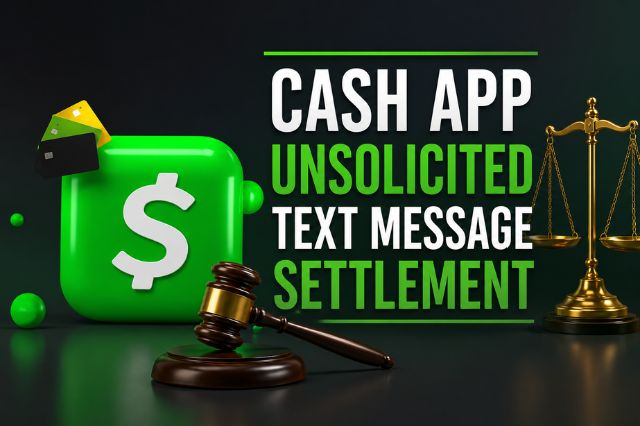
Bottoms v. Block, Inc. is a class action lawsuit filed in the U.S. District Court for the Western District of Washington, Case No. 2:23-cv-01969-MJP. The lawsuit alleged that Block, Inc., the parent company of Cash App, violated Washington's Commercial Electronic Mail Act and the Washington Consumer Protection Act by assisting users in sending unsolicited referral text messages through the Cash App Invite Friends program without recipient consent. Block agreed to a $12.5 million settlement. The court granted final approval on December 2, 2025. Payments of $394.36 per approved claimant began distributing on February 2, 2026.
• Block, Inc. settled the Cash App spam text lawsuit for $12.5 million without admitting wrongdoing.
• Eligible class members are Washington state residents who received an unsolicited Cash App referral text between November 14, 2019, and August 7, 2025.
• The court-approved payout is $394.36 per accepted claim, significantly above early estimates of $88 to $147 per person.
• The claims deadline was October 27, 2025; the court granted final approval on December 2, 2025, and payments began February 2, 2026.
• This case is separate from the Cash App security settlement involving data breaches, which is governed by different eligibility rules.
The Cash App text message settlement, formally known as Bottoms v. Block, Inc., arose from a class action complaint filed in late 2023 by plaintiff Kimberly Bottoms in the U.S. District Court for the Western District of Washington. The lawsuit targeted Block, Inc., the parent company of Cash App, over the platform's Invite Friends referral program.
The Invite Friends feature allowed Cash App users to send pre-filled text messages to their personal contacts encouraging those contacts to sign up for Cash App using a unique referral code. Recipients of these messages would receive a text such as: "Hey! I've been using Cash App to send money and spend using the Cash Card. Try it using my code and you'll get $5." Critically, these messages were sent without the prior express consent of the recipients. The lawsuit alleged that Block did not merely provide a neutral platform but actively incentivized and assisted users in transmitting these commercial messages, making Block legally responsible under Washington state law.
Block, Inc. denied any wrongdoing but agreed to settle the case for $12.5 million to avoid the cost and risk of continued litigation. After preliminary court approval on July 29, 2025, U.S. District Judge John Chun granted final approval on December 2, 2025, declaring the settlement fair, reasonable, and adequate and in the best interests of the settlement class.
The Cash App marketing text lawsuit rested on two primary legal theories under Washington state law, both of which have direct relevance to how courts in the United States treat unsolicited commercial electronic communications.
Washington's Commercial Electronic Mail Act prohibits the transmission of unsolicited commercial electronic mail messages, including text messages, to Washington residents without their clear and affirmative prior consent. The law was amended in 2003 to explicitly cover text messages. Critically, CEMA extends liability not only to the party who sends a message but also to any party that initiates or assists in transmitting such messages. This provision formed the core of the Cash App TCPA-style claim: plaintiffs argued that Block assisted its users in sending these commercial texts by designing, hosting, and financially incentivizing the Invite Friends program.
The Washington Consumer Protection Act prohibits unfair or deceptive acts and practices in trade or commerce. Plaintiffs argued that Block's practice of systematically encouraging the mass distribution of unsolicited commercial texts constituted an unfair business practice. Together, the two statutes provided plaintiffs with a strong dual-pronged legal foundation for the Cash App unwanted text messages lawsuit.
While the Bottoms case was brought under Washington state law rather than the federal Telephone Consumer Protection Act, the underlying conduct mirrors the type of activity the TCPA targets at the national level. The federal TCPA prohibits companies from using automated systems to send marketing text messages without prior express written consent. The Cash App robocall settlement analysis offered by legal commentators noted that even under federal standards, Block's referral program would face serious legal scrutiny. The Washington case demonstrates how state consumer protection statutes can fill enforcement gaps where federal law may not directly apply.
Cash App text message settlement eligibility was defined precisely by the court-approved settlement agreement. To be a member of the settlement class, a person had to meet all three of the following criteria:
1. The person received a Cash App referral program text message between November 14, 2019, and August 7, 2025.
2. The person was a Washington state resident at the time the text message was received.
3. The person did not clearly and affirmatively consent in advance to receive Cash App referral program text messages.
The settlement administrator, EisnerAmper, verified eligibility by cross-referencing claimant-provided phone numbers against Block's own records of Invite Friends texts sent to Washington area code numbers. Class members whose phone numbers appeared in Block's records were eligible to file a claim. The settlement covered approximately 1,975,187 potential class members across Washington state.
It is important to note that receiving a referral text through Cash App's Invite Friends feature is distinct from receiving a request or payment notification. Referral texts did not inform recipients that someone sent or requested money; they were purely marketing messages designed to grow Cash App's user base. That distinction was legally significant because it confirmed the commercial nature of the communication.
Early court filings estimated the Cash App settlement payout per person at between $88 and $147, based on a projected claim filing rate of approximately 5 percent of all eligible class members. Those projections proved significantly off. Because the actual number of claimants was far lower than anticipated, the per-person award rose substantially.
The final court-approved Cash App settlement payout per person is $394.36 per accepted claim. After deducting attorney fees of $3.1 million (25 percent of the total fund) and the class representative award of $10,000, approximately $8.7 million remained to fund individual payments.
• Final court approval: December 2, 2025.
• Payment distribution began: February 2, 2026.
• Reissue requests deadline: March 18, 2026.
• Anticipated delivery of reissued checks: April 8, 2026.
• Settlement administrator contact: info@BottomsTextSettlement.com or 1-877-540-7545.
The official Cash App settlement website for this case is BottomsTextSettlement.com. Claimants who had not received payment by the expected date were advised to contact the settlement administrator directly. The claim filing deadline was October 27, 2025, and no new claims are being accepted.
Many consumers searching for Cash App settlement information encounter references to two different cases. The Cash App spam text lawsuit described in this article is entirely separate from the Cash App security settlement, formally known as Salinas, et al. v. Block, Inc. and Cash App Investing, LLC, Case No. 22-cv-04823, pending in the Northern District of California.
The security settlement arose from two separate data breach incidents: one involving a former Cash App employee who accessed customer data without authorization after leaving the company, and another involving unauthorized access to some Cash App accounts through recycled phone numbers. That case settled for $15 million and provided eligible claimants with up to $2,500 for documented out-of-pocket losses related to unauthorized account access or fraudulent transactions. The eligibility rules, claim form process, settlement website (cashappsecuritysettlement.com), and payment timeline are different from those of the spam text settlement. Consumers should verify which case applies to their specific circumstances before filing any claim.
The Cash App unsolicited text message settlement raised several significant legal complications that courts, practitioners, and legal scholars have noted in the consumer protection space.
First, the question of third-party liability was central. Block argued that its users, not Block itself, sent the referral texts. The plaintiffs and ultimately the court's settlement approval process acknowledged that CEMA's broad definition of parties who assist in transmitting commercial messages extended liability upstream to Block as the platform operator. This interpretation has significant implications for any app or platform that offers referral-based marketing features.
Second, the consent question proved legally complex. Cash App's terms of service and the user-initiated nature of the texts created arguments that recipients had some form of implied consent because the texts came from people they knew. Courts and the settlement framework rejected this reasoning, reinforcing the rule that consent must be clear and affirmative from the recipient, not inferred from the sender's relationship with the recipient.
Third, the geographic limitation of the settlement to Washington state highlights a recurring complication in multi-state consumer protection litigation: the patchwork nature of state anti-spam and consumer protection laws means that residents of other states who received identical messages may have no equivalent legal remedy under their own state laws.
How do I know if I'm part of the Cash App settlement?
You qualify if you were a Washington state resident who received an unsolicited Cash App Invite Friends referral text between November 14, 2019, and August 7, 2025, without giving prior consent; the claims deadline of October 27, 2025, has now passed.
Is the Cash App settlement legit?
Yes, Bottoms v. Block, Inc. is a federally court-approved class action settlement; final approval was granted by U.S. District Judge John Chun on December 2, 2025, and payments of $394.36 per claimant began on February 2, 2026.
How much will each person get from the Cash App settlement?
Each approved claimant receives $394.36, far above the original estimate of $88 to $147 per person, because fewer claimants filed than initially projected from the 1.97 million eligible class members.
Why did Cash App users receive a class action settlement for spam texts?
Block, Inc. was sued for violating Washington's Commercial Electronic Mail Act by assisting users to send unsolicited Invite Friends referral texts to Washington residents without their clear and affirmative prior consent.
How do I claim the Cash App settlement in 2026? The claim filing deadline was October 27, 2025, and no new claims are being accepted; approved claimants who have not received payment should contact the settlement administrator at info@BottomsTextSettlement.com or call 1-877-540-7545.
Disclaimer
This article is published on LegalAnalysis.org for informational and educational purposes only and does not constitute legal advice. It does not create an attorney-client relationship. All information is based on publicly available court records, settlement documents, and media reports as of June 2026. Settlement deadlines, payment amounts, and eligibility rules are subject to change; readers should verify current information at BottomsTextSettlement.com or consult a licensed attorney for guidance specific to their circumstances.
Sponsored Ads

Sponsored Ads