
Sponsored Ads

Sponsored Ads

Introduction
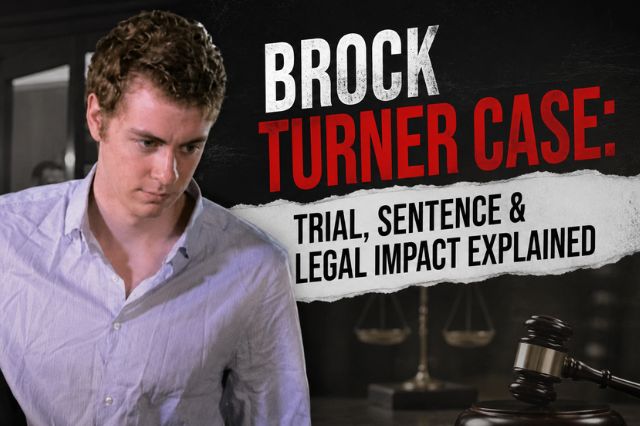
Few campus sexual assault cases have reshaped American legal discourse the way the People v. Turner case did. What began as a January 2015 assault behind a fraternity house at Stanford University evolved into a national reckoning over judicial discretion, victim rights, and sentencing reform. Nearly a decade later, the Brock Turner case remains a textbook example of how a single sentencing decision can trigger legislative change and even the recall of a sitting judge. This article examines the trial, the controversial sentence, and the legal reforms that followed using officially documented facts from court records, legislative archives, and verified news reporting.
Background of the Case
On January 18, 2015, Brock Allen Turner, then a 19-year-old Stanford University swimmer, sexually assaulted an unconscious 22-year-old woman, later publicly identified as Chanel Miller, outside a fraternity party on campus. The assault occurred beside a dumpster after the victim had blacked out from intoxication. Two graduate students cycling past the scene intervened, restrained Turner, and alerted police, leading to his arrest the same night.
Turner was charged with five felony counts, including rape of an unconscious person, assault with intent to commit rape, and sexual penetration of an intoxicated and unconscious person by a foreign object.
The Trial and Conviction
The case went to trial in March 2016 in Santa Clara County Superior Court. A jury found Turner guilty on three felony charges: sexual penetration with a foreign object of an intoxicated person, sexual penetration with a foreign object of an unconscious person, and assault with intent to commit rape. The prosecution presented eyewitness testimony from the two students who stopped the assault, along with forensic evidence, while the defense argued the encounter was consensual, a claim the jury rejected.
Under California law at the time, Turner faced a potential maximum sentence of 14 years in state prison.
The Sentencing Decision
On June 2, 2016, Judge Aaron Persky sentenced Turner to six months in county jail, three years of probation, and lifetime registration as a sex offender. The probation department had recommended a moderate jail term, and Persky adopted a lenient approach, citing several mitigating factors. According to reporting from The Associated Press, Persky said he was following the probation department's recommendation to spare Turner a prison term for several reasons, including Turner's youth, his lack of a prior criminal record, and his level of intoxication at the time of the offense.
Turner ultimately served only three months of the six-month sentence before being released from county jail in September 2016, a fact that intensified public outrage over what many viewed as an inadequate consequence for a violent felony conviction.
The Victim Impact Statement That Went Viral
What elevated this case from a local court proceeding into a national conversation was the victim's impact statement, read aloud during sentencing and later published in full by BuzzFeed News. The statement recounted the ordeal of the investigation and trial, including cross-examination about her drinking habits and sexual history. In one of its most quoted lines, she told Turner, "You took away my worth, my privacy, my energy, my time, my intimacy, my confidence, my own voice, until today."
The statement was read by millions within days and was even entered into the Congressional Record by then-Congresswoman Jackie Speier. It became a cornerstone document in conversations about how the justice system treats survivors of sexual assault, particularly regarding cross-examination tactics and sentencing leniency.
The Recall of Judge Aaron Persky
Within days of the sentencing, a Stanford law professor and friend of the victim, Michele Dauber, launched a campaign to recall Judge Persky. Recall organizers formally filed their petition in June 2017, needing to collect 58,634 valid signatures within 160 days to qualify the recall for the ballot.
The recall went to a vote on June 5, 2018. Santa Clara County voters recalled Persky, marking the first time since 1932 that California voters had removed a sitting judge. Dauber, who led the campaign, stated that the vote reflected a broader message that violence against women had become a defining voting issue.
Notably, the state's Commission on Judicial Performance, the body responsible for disciplining state judges, had reviewed the sentencing and found that Persky had handled it appropriately under existing law, a fact that fueled an ongoing academic and legal debate about whether the recall was a justified check on judicial overreach or a dangerous precedent threatening judicial independence. As one 2023 retrospective piece on the case noted, some later commentary, including a documentary re-examining the recall, questioned whether removing an otherwise compliant judge over a single unpopular ruling could discourage judges from exercising individualized discretion in future sentencing decisions.
Legislative Reform: Assembly Bill 2888
The public backlash didn't stop at the ballot box. California lawmakers moved quickly to close the legal loophole that had allowed for a lenient sentence in a case involving an unconscious victim. The state legislature passed Assembly Bill 2888, which was signed into law and eliminated judicial discretion to grant probation in place of prison time for defendants convicted of sexually assaulting an unconscious or severely intoxicated victim. This reform effectively mandated prison time in cases with fact patterns similar to Turner's, closing what critics had called a "consent-based loophole" that previously allowed judges broad flexibility in incapacitated-victim cases.
A companion measure, Assembly Bill 701, later expanded the legal definition of rape to include acts previously charged only as "sexual penetration by foreign object," addressing another gap exposed by the case's charging structure.
Legal Significance and Ongoing Debate
From a legal analysis standpoint, the Brock Turner case illustrates several enduring tensions within the American criminal justice system:
- Judicial discretion versus public accountability - The case tested how much latitude judges should retain in sentencing, especially in politically charged cases, and whether recall elections are an appropriate check on that discretion.
- Sentencing disparities in sexual assault cases - Legal scholars have repeatedly cited the case when examining inconsistent sentencing outcomes for similarly situated defendants, particularly along lines of privilege and perceived future potential.
- The role of victim testimony in sentencing reform - The viral impact statement demonstrated how a single victim's public account can catalyze statutory change far beyond the individual case.
Legal commentary on the case, including detailed reviews published in the Harvard Law Review, has continued to treat People v. Turner as a foundational study in the intersection of judicial independence, legislative response, and public accountability in sexual assault sentencing.
Conclusion
The Brock Turner case remains one of the most consequential sexual assault prosecutions in modern American legal history, not because of novel legal theory, but because of its aftershocks: a landmark judicial recall, sweeping sentencing reform, and a victim's statement that reshaped public understanding of survivor impact in the courtroom. For legal practitioners, policymakers, and students of criminal law, the case offers a lasting lesson in how public accountability and legislative action can follow when the justice system's discretion is perceived to fail survivors.
Sponsored Ads

Sponsored Ads